Sound Bath Meditation
What is a sound bath meditation? Discover the benefits, what a session feels like, how long it lasts, and how to find a sound healing practitioner near you or online.

A sound bath meditation is a guided session in which you lie down, relax, and are “bathed” in overlapping sounds and vibrations — usually from crystal or metal singing bowls, gongs, and chimes — while a practitioner plays them. A typical sound bath lasts 45 to 60 minutes. People use it to downshift the nervous system, ease stress, and improve sleep, and small studies link singing-bowl meditation to reduced tension and better mood, though the research is still early. You can experience one in person or in a live online session. Below: what a sound bath is, how it works, what to expect at your first, and how to find a practitioner.
What is a sound bath meditation?
A sound bath is a meditative experience in which you rest — usually lying down — while a practitioner plays a series of resonant instruments, so you’re surrounded, or “bathed,” in sound and vibration. Despite the name, there’s no water involved; the “bath” refers to being immersed in waves of sound. Sessions are typically led with crystal or metal singing bowls, gongs, tuning forks, and chimes, sometimes layered with voice or percussion.
Unlike a guided meditation where you follow spoken instructions, a sound bath asks very little of you: you settle in, close your eyes, and let the sound do the work. It’s often described as a deeply relaxing form of sound-assisted meditation, suitable for complete beginners.
How does a sound bath work?
During a sound bath, the practitioner plays instruments at different tones and rhythms, creating continuous, overlapping sound. The idea is that these steady, immersive sounds give your mind something gentle to rest on, making it easier to slip out of busy “thinking” mode and into a calm, meditative state — similar to how focusing on the breath works in other meditations.
Practitioners often describe this as helping the body shift from a stress response toward a “rest and digest” state. It’s best understood as a relaxation and meditation practice, not a medical treatment — the value comes from deep rest and stillness rather than from any measurable effect of specific frequencies on the body.
Sound bath benefits: what the research does and doesn’t show
Most people come to sound baths for relaxation, stress relief, and better sleep, and there is some early scientific support for those experiences — though it’s important to be honest about how limited it is.
- Stress and tension. A small 2017 study of singing-bowl sound meditation found participants reported significantly less tension, anger, and fatigue afterward, and improved mood (Goldsby et al., Journal of Evidence-Based Integrative Medicine).
- Relaxation and sleep. Like other meditation and relaxation practices, sound baths are widely reported to promote calm and help with winding down before sleep. Broader evidence for meditation’s role in stress reduction is summarized by the U.S. National Center for Complementary and Integrative Health (NCCIH).
- Mood and wellbeing. Early findings are positive but come from small studies, so they should be read as promising rather than proven.
What a sound bath cannot do is cure illness or replace medical or mental-health care. Think of it as a complementary practice for relaxation and stress — a way to rest deeply — not a treatment. If you’re managing a health condition, keep it alongside, not instead of, professional care.
What to expect at your first sound bath
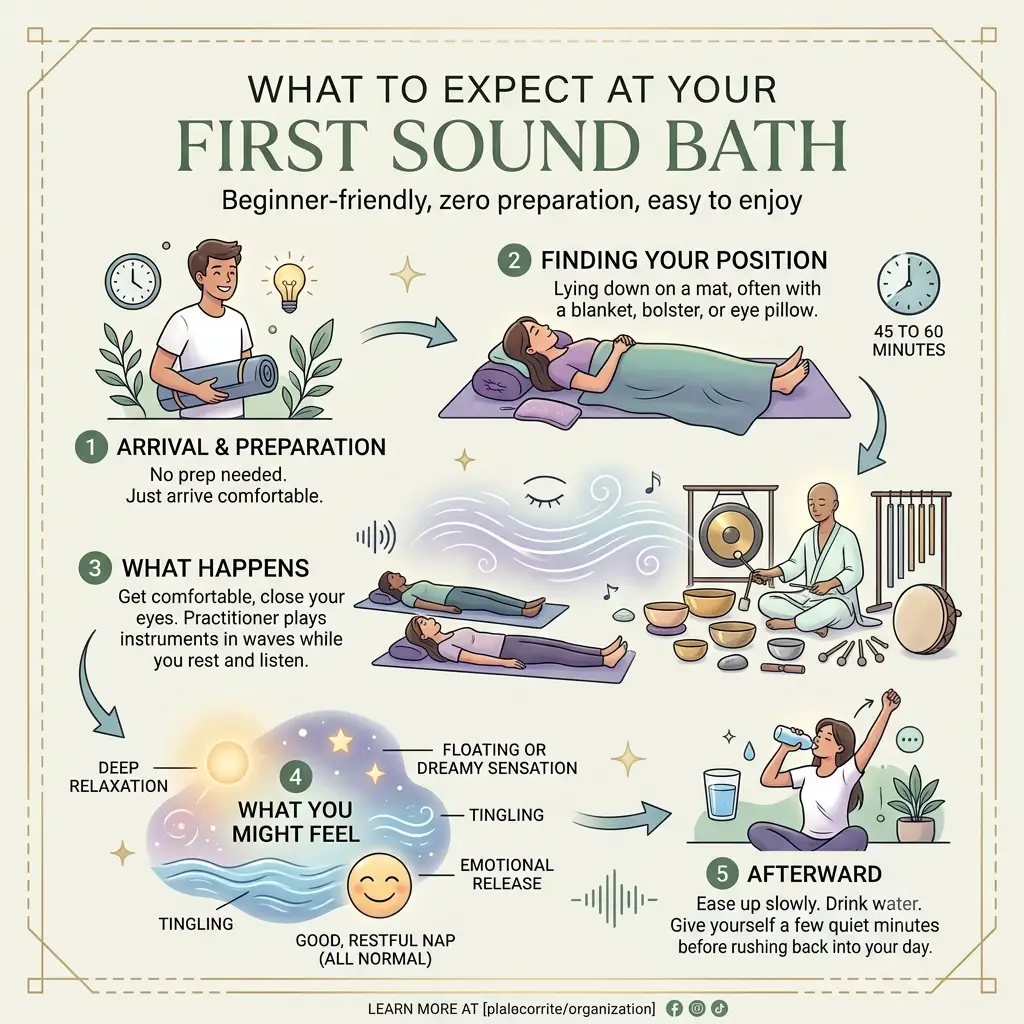
Sound baths are beginner-friendly and easy to enjoy with zero preparation. Here’s the typical flow:
- Duration: 45–60 minutes.
- Position: lying down on a mat, often with a blanket, bolster, or eye pillow.
- What happens: you get comfortable, close your eyes, and the practitioner plays the instruments in waves while you simply rest and listen.
- What you might feel: deep relaxation, a floating or dreamy sensation, tingling, emotional release, or sometimes just a good, restful nap — all normal.
- Afterward: ease up slowly, drink water, and give yourself a few quiet minutes before rushing back into your day.
How long is a sound bath?
Most sound baths last 45 to 60 minutes, though shorter 30-minute sessions and longer 75–90-minute experiences also exist. Private or online sessions can be tailored to whatever length you prefer.
What to wear to a sound bath
Wear loose, comfortable, warm clothing you can relax and lie down in — think soft layers rather than anything restrictive. Because your body cools while lying still, it’s worth bringing an extra layer or a blanket, and removing shoes and bulky accessories so you can fully settle.
Sound baths for sleep and stress
The two most common reasons people book a sound bath are stress relief and better sleep. The deeply relaxing, low-effort nature of the practice makes it a gentle way to calm a busy mind, and many people find an evening sound bath helps them unwind before bed. Used regularly alongside good sleep habits, it can be a soothing part of a wind-down routine — a restful reset rather than a cure for insomnia.
Instruments: singing bowls, gongs, and more
Sound baths are built around resonant instruments, each with its own character:
- Crystal singing bowls — clear, sustained tones that are the signature sound of many sound baths.
- Metal (Tibetan) singing bowls — warmer, layered overtones with a long history in meditation traditions.
- Gongs — full, immersive waves of sound, often used in “gong bath” sessions.
- Chimes, tuning forks, and bells — brighter accents that add texture and space.
If you’re drawn to a particular sound, ask a practitioner what they use — many specialize in gong baths or crystal-bowl sessions.
How to find a sound bath (near you or online)
You can experience a sound bath in three main ways: an in-person group session at a studio, a private session (in person or live online), or a recorded audio track. Live sessions — in person or over video — are the most immersive, because a practitioner responds to the room in real time; recordings are convenient but more generic.
When choosing a practitioner, look for someone with genuine training and experience, clear and honest descriptions of what a session involves, and reviews from past participants. On Heallist, you can find and connect with sound healing and meditation practitioners offering sessions in person or online.
🔗 Find a sound healing practitioner on Heallist →
Frequently asked questions
What is a sound bath meditation? A sound bath meditation is a guided session in which you lie down and relax while a practitioner plays resonant instruments — such as crystal singing bowls, gongs, and chimes — surrounding you in continuous sound and vibration. It’s a deeply relaxing, beginner-friendly form of sound-assisted meditation.
What are the benefits of a sound bath? Sound baths are mainly used for relaxation, stress relief, and better sleep. A small study found participants reported less tension and improved mood after singing-bowl meditation, though research is still early. They’re best seen as a complementary practice for rest, not a medical treatment.
How does a sound bath work? The practitioner plays overlapping tones and rhythms that give your mind something calm to rest on, helping you shift from a busy, stressed state into a relaxed, meditative one — much like focusing on the breath in other forms of meditation.
How long is a sound bath? Most sound baths last 45 to 60 minutes, though 30-minute and 75–90-minute sessions also exist. Private and online sessions can be tailored to your preferred length.
What do you wear to a sound bath? Wear loose, comfortable, warm clothing you can lie down and relax in, and bring an extra layer or blanket since your body cools while resting. Remove shoes and bulky accessories so you can fully settle.
Can a sound bath help you sleep? Many people find sound baths help them unwind and sleep better thanks to the deep relaxation they promote. Used alongside good sleep habits, an evening session can be a soothing part of a wind-down routine, though it isn’t a cure for insomnia.
Are sound baths scientifically proven? There is early, limited evidence — small studies link singing-bowl meditation to reduced tension and improved mood — but the research is not yet conclusive. Sound baths are a relaxation and meditation practice, not a proven medical treatment.
Can you do a sound bath online? Yes. Many practitioners offer live online sound baths over video, which let you experience a real, responsive session from home. Pre-recorded audio sound baths are also available for convenience.
Ready to try a sound bath?
You can find and book a sound healing practitioner on Heallist for an in-person or online sound bath.
Find a sound healer on Heallist →
